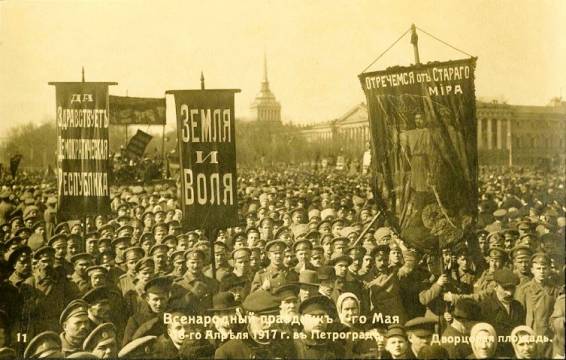
Left: The May First demonstration in Petrograd on Old Style April 18, 1917 (New Style May 1).
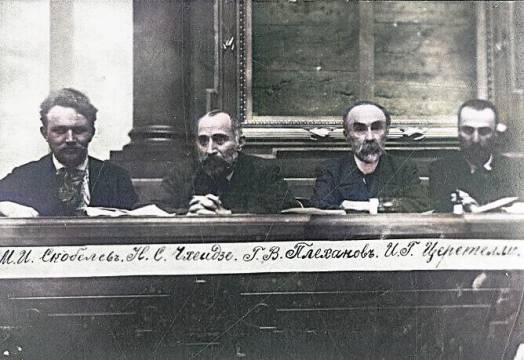
Right: Presidium of the first All-Russian Congress of Soviets; left to right, Skobelev, Chkheidze, Plekhanov and Tsereteli
Sources: webpage and Lunapic
1. THE TASKS OF THE PROLETARIAT IN THE PRESENT REVOLUTION.
I did not arrive in Petrograd until the night of April 3. Consequently I delivered the report on the tasks of the revolutionary proletariat at the April 4 meeting exclusively on my own behalf, with reservations due to insufficient preparation.
[...]
THESES
1) In our attitude towards the war, the slightest concession to "revolutionary defencism" is impermissible. Under the new government of Lvov and Co. the war unquestionably remains a predatory imperialist war on Russia's part owing to the capitalist nature of the government.
[...]
2) The specific feature of the present situation in Russia is that the country is passing from the first stage of the revolution, which yielded power to the bourgeoisie because of the insufficient class-consciousness and organization of the proletariat, to its second stage which must place power in the hands of the proletariat and the poorest peasants.
[...]
3) No support for the Provisional Government. The utter falsehood of all its promises should be made clear, particularly the ones related to a renunciation of annexations. Exposure rather than "demands" that this government of capitalists should cease being imperialist.
4) Recognition of the fact that our Party is a minority in most Soviets of Workers' Deputies; it is a small minority compared with the bloc of all petty-bourgeois opportunist elements: Popular Socialists, Socialist-Revolutionaries, the Organizing Committee (Chkheidze, Tsereteli, etc.),1 Steklov, etc., etc., who have succumbed to the influence of the bourgeoisie and spread it among the proletariat.
[...]
5) For a "parliamentary republic" no longer, but now for a republic of Soviets of Workers', Agricultural Labourers' and Peasants' Deputies throughout the country from top to bottom. To keep advocating a parliamentary republic when the Soviets of Workers' Deputies are in existence is a retrograde step.
Abolition of the police, the army and the bureaucracy.2
The salaries of all officials to not exceed the average wage of a competent worker. All officials must be eligible and subject to summary dismissal at any time.
6) The agrarian programme must emphasize and shift its weight to the Soviets of Agricultural Labourers' Deputies.3
Confiscation of all the landed estates.
Nationalization of all lands in the country, the land to be disposed of by local Soviets of Agricultural Labourers' and Peasants' Deputies.
Creation of separate Soviets of Deputies of Poor Peasants.4
Set up a model farm on every large confiscated estate (100 to 300 dessiatines in size).5 Implementation according to local conditions and to the decisions of local bodies controlled by the Soviets of Agricultural Labourers' Deputies.
7) The immediate amalgamation of all the banks in the country into a single national bank under the control of the Soviet of Workers' Deputies.
8) Our immediate task is not to "introduce" socialism but only to bring social production and distribution of goods at once under the control of the Soviets of Workers' Deputies.
9) Party tasks:
(a) Immediate convocation of a Party congress.
(b) Modification of the Party Programme on (i) imperialism and the imperialist war, (ii) the state and the "commune state",6 and (iii) the "minimum programme" (now outdated).
(c) Modification of the Party's name.7
10) A new International. We must take the initiative in creating a revolutionary International, an International against the social-chauvinists and against the "Centre".8
[...]
2. TWO GOVERNMENTS IN RUSSIA.
Paris: Telegraphs from Petrograd say that the Government attempts to reconcile its policies with the extreme tendencies of the soviet of workers and soldiers. The latter incites the advanced factions to "very frequent and dangerous clashes."
Petrograd: The situation in Krondstat is serious. Twenty-four thousand sailors have taken over the town and imprisoned two hundred officers. The sailors destroyed the maps and charts pinpointing the location of sea mines at the entrance to the harbour. As a consequence the warships can not exit the naval base.
Paris: Telegraphs from Petrograd say that the Russian danger does not lie in the negotiation of a separate peace but in the surprise that the peasant masses may give, dazzled as they are by the suggestion of a redistribution of the land.
It is believed that the Congress of workers, peasants and soldiers scheduled for the end of May in Petrograd will evolve into a Constituent Assembly. The Army favours a removal of the Congress to Moscow, but the workers of Petrograd understand that they would forfeit much of their authority if the Congress were moved to a city where they lack strength.
Lyon: The May 2 communiqué of the Russian Minister of Foreign Affairs pledged that although political adversaries may strive to sow discord Russia will remain resolute and fight until final victory.
Paris: The newspapers of Petrograd review the peace terms handed to Russia by the German Socialist "Bergberg" (?).
A Russian regiment refused to march to the front, alleging that it had overstayed previously. Three Duma deputies rushed to the regiment's position, delivered eloquent exhortations and succeeded in restoring discipline.
Paris: Official circles in Petrograd believe that the Constituent Assembly will convene by October 10 at the latest.
Petrograd: There are repeated attempts to blow up railway tracks. A plot to blow up Kamenostrovski Bridge was uncovered.
The official organ of the Soviet of workers and soldiers carries an article warning about the anarchy fostered by the existence of many small independent revolutionary communities and by demands of workers all over Russia.
Almost all trades threatened to go on a general strike if the workday is not pared down to six hours.
Petrograd: An American diplomatic mission has arrived in the city.
The Government adopted measures against "certain political parties" implicated in "the maneuvers of an enemy power" to nudge Russia aside to a separate peace.
The Government is determined to expel Robert Grimm for collusion with those maneuvers.
The Black Sea chapter of the "Knights of St. George" has created an organizing committee for a revolutionary army of volunteers in Petrograd.
The committee proposes creating battalions that will spur regular troops to charge. Numerous bids to enlist were received from all over Russia.
London: A newspaper details the propaganda of anarchists who managed to enter Russia.
Speeches continue to be heard in Petrograd that urge peace at all costs.
| And Now For Something Completely Different |